.svg)


Ask a grower what limits their harvest and most will say they cannot find enough pickers. Watch a shift and you see something more specific. The limit is rarely how fast someone can pick. It is everything that happens around the picking.
A picker's hour is a string of tasks done one after another: walk to the room, get set up, find the next mushroom, pick it, cut the stem, check the quality, place it in a punnet, weigh it, close the box, swap the full stack for empties, move the trolley, start again.
Only one of those is picking. The rest is handling, moving and setting up, and it happens in sequence because one person can only do one thing at a time.
That is what engineers call serial work, and it has a hard ceiling. A picker can look ahead to the next mushroom while placing the current one, and good pickers do. But nobody can pack a box and unload a full stack at the same moment. The ceiling is not effort or skill. It is the shape of the task.
The way out is to do several of those steps at once, which means giving them to different hands.
The clearest example is packing. On a traditional shelf farm, a picker carries a knife and a box and does everything themselves. Add a conveyor along the aisle and the job changes shape: the picker picks with both hands and puts uncut mushrooms on the belt, and the cutting, weighing and boxing happen somewhere else, at the same time, by a machine that only does that.
Nothing about the picking got faster. Roughly half of the harvest work simply stopped being done by the person on the bed.
The other large source of lost time is travel. Beds are stacked six levels high down long rooms. Reaching them means climbing, moving platforms and walking, and none of that time produces anything.
Drawer systems invert the problem. Instead of sending the picker to the bed, the bed comes to the picker on a moving platform, at a comfortable height, one after another. Travel disappears from the job.
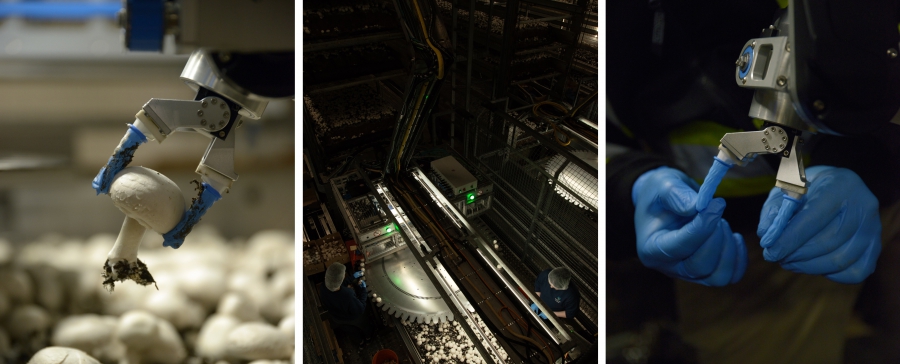
For a machine, this matters even more than it does for a person. A robot that has to drive itself around a farm needs to navigate, carry its own power, handle obstacles and survive being bumped. A robot bolted to a fixed frame, with the crop arriving in front of it, needs to do none of those things. It is cheaper, simpler and far more reliable, and almost all of its running time is spent doing the actual work.
This is why there is no single right answer for automating a harvest, and why we build for two situations rather than one.
On existing shelf farms, rebuilding the rooms is not realistic, so the gain comes from taking a whole task off the bed. The belts are already there on many farms. Packing moves to one place and gets automated there.
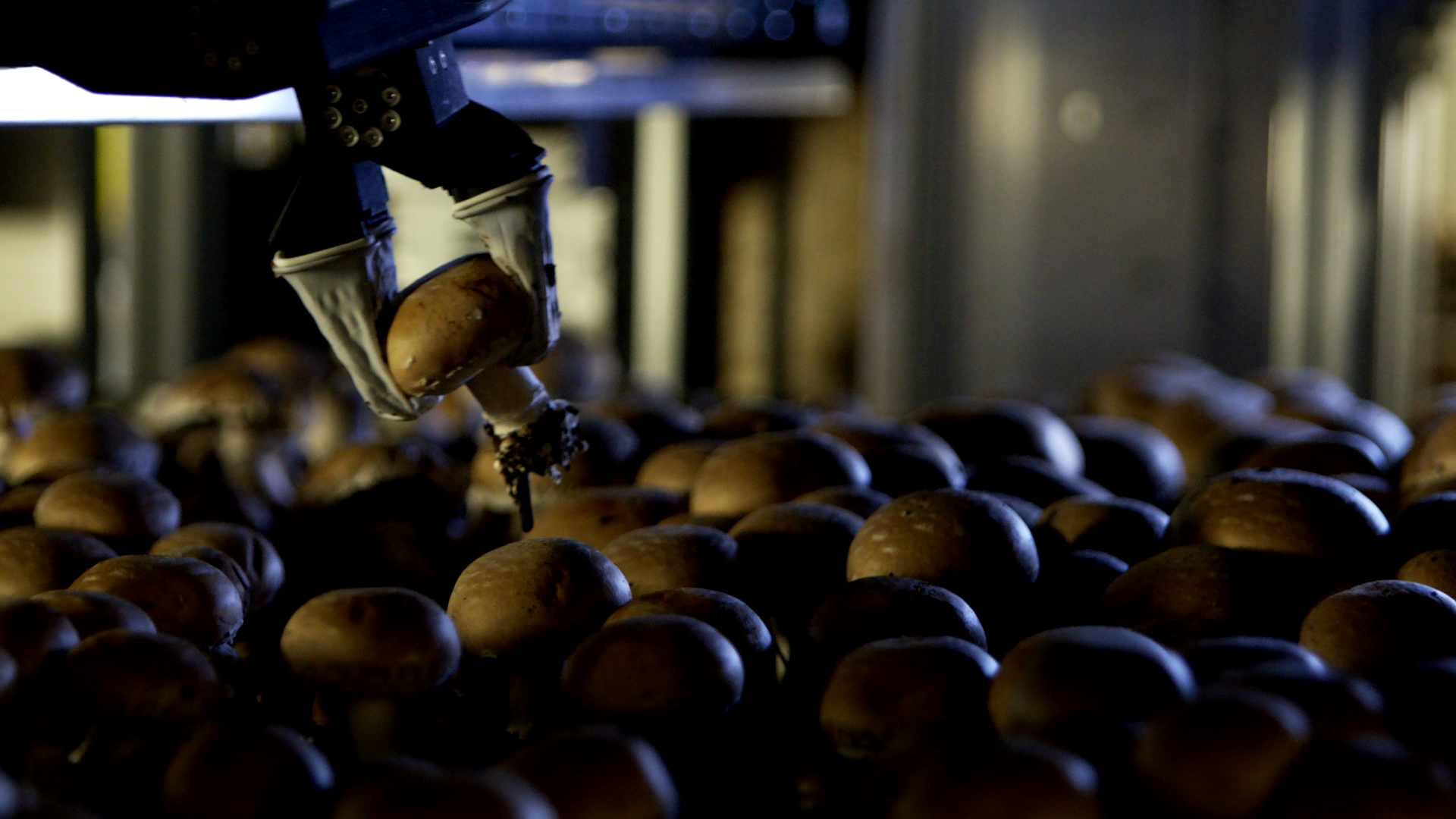
On new drawer farms, the crop already travels to a fixed point, so both picking and packing can be done by machines standing in that spot, with people handling the parts that need judgment.
Same principle, two different starting points.
It is tempting to treat harvest improvement as a speed problem: faster hands, faster machines, more of both. But the crop is growing at about 4% an hour while all this happens. An hour spent walking to a room is an hour the mushrooms spent getting bigger than the order allows.
Assembly lines made the same discovery a century ago. The gain did not come from people working faster. It came from stopping people carrying parts around, and letting each pair of hands do one thing well while the work moved past them.
A mushroom room is a harder version of the same problem, because the parts are alive and on a deadline. The answer has the same shape: stop moving the people, split the chain, and let each step happen at the same time as the others.
Curious to learn more? Check out our Resources page.
.svg)

.svg)


.svg)
.svg)


