.svg)


People have been building machines to pick mushrooms since the 1970s. Research institutes, equipment makers, growers with a workshop and a good idea. Very few of those machines are on a farm today.
That history is usually told as a warning. We think it is more useful as an explanation, because the reason they failed is not the one most people assume.
To replace a pair of hands on a mushroom bed, a machine has to do three things, and it has to do all of them together:
Any two of the three gets you a prototype and a good demonstration video. All three gets you a product. For fifty years, almost everyone got two.
Classical machine vision was built for factories, where the object is known, the lighting is fixed and the part arrives in the same orientation every time. A mushroom bed is the opposite of all three.
The mushrooms overlap. They are different sizes and angles. They sit in a gap of about 20 centimetres between one bed and the one above it, which is closer than most industrial cameras can focus. The lighting is whatever the room has. And the scene changes every hour, because the crop is growing while you look at it.
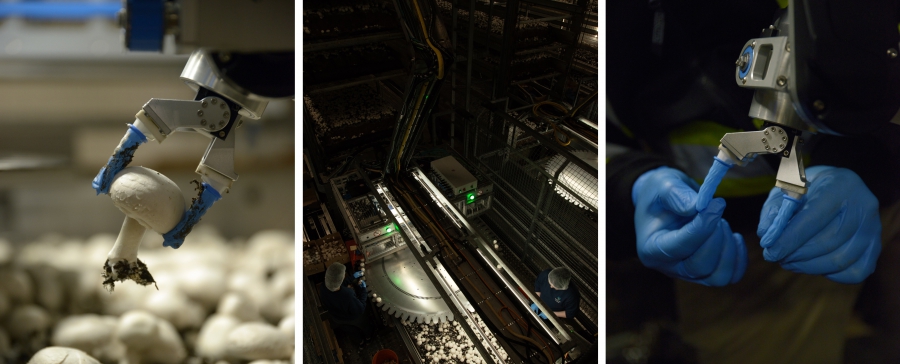
A mushroom has no skin to protect it. Bruising is invisible on the bed and appears later in the cooler, so a machine can pass its own inspection and still fail the customer's.
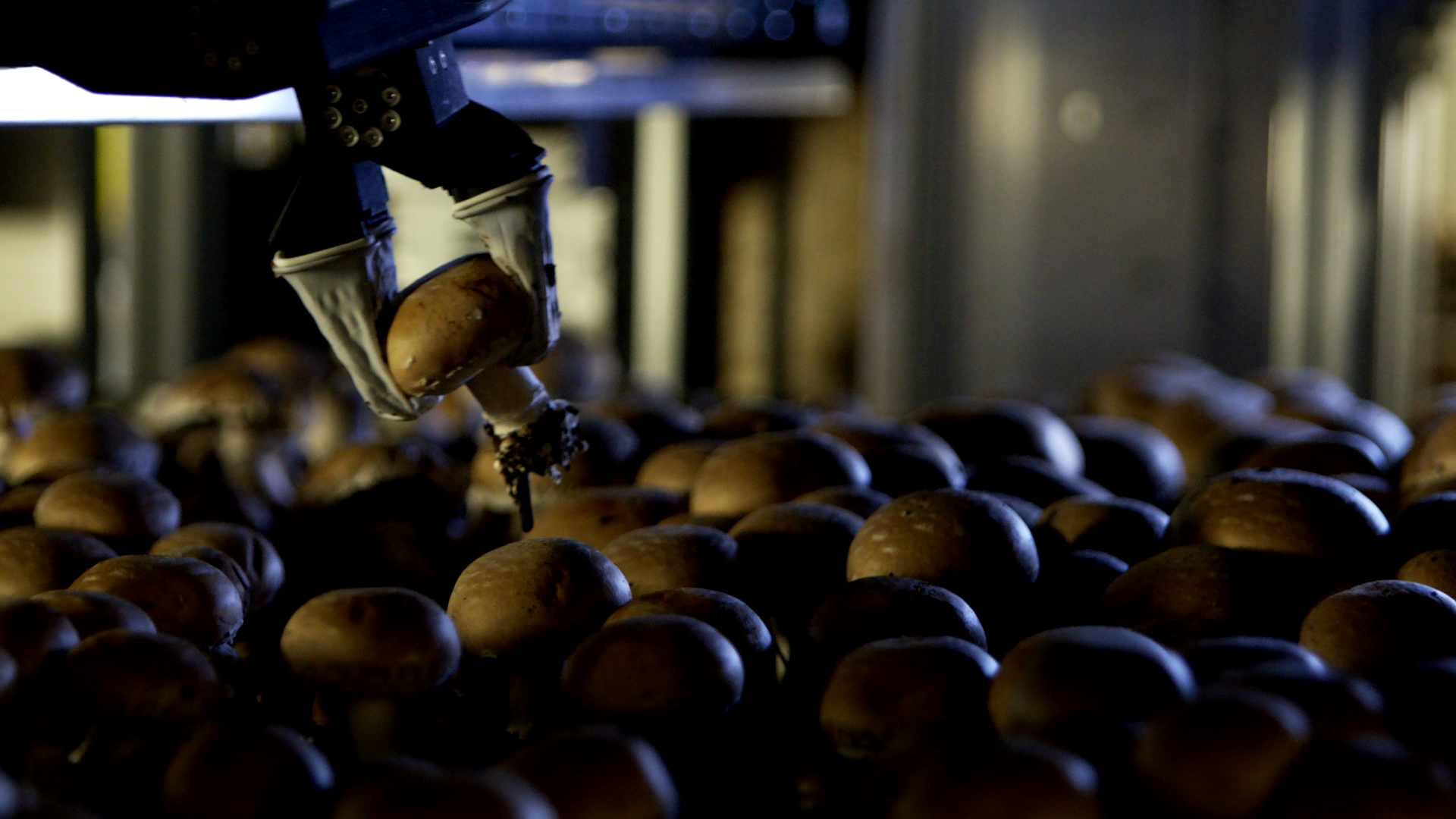
It also has to come off the compost. The stem is anchored, and the bond between stem and compost is stronger than the bond between cap and stem, so pulling straight up takes the cap off and leaves the stem behind. Releasing it properly means tilting and twisting, which is exactly the motion that shears the skin if you get it slightly wrong.
This is the one that actually killed most attempts, and it gets the least attention.
Hand picking is not expensive when there are hands available. For decades there were. So the machine was not competing against an impossible job; it was competing against a cheap one. A system that needed specialist maintenance, custom parts and a rebuild of the growing rooms could work beautifully and still never pay for itself.
Most of the failures in this field were engineering successes and business failures. The machine picked mushrooms. It just cost more than the people it replaced, so nobody ordered a second one.
Four things, roughly over the last decade, and none of them on their own would have been enough.
Computing got small and cheap. The processing that once needed a cabinet now fits on a board that rides on the machine next to the bed, at a fraction of what a comparable industrial vision system cost ten years ago.
Machine learning changed what vision can handle. Recognising an irregular object in a cluster, in poor light, at an angle, is precisely what modern vision models are good at and what rule-based vision was bad at.
Farms became automatable. Conveyors, trolleys, mechanical filling and, more recently, drawer systems gave a machine somewhere to mount and something predictable to work against. A machine designed for a wooden tray farm in 1978 had nothing to hold on to.
The labour disappeared. Farms across North America and Europe now cannot fill picking positions at wages they can afford, and the worker programmes many relied on are shrinking. The bar the machine has to clear moved, and it moved in the machine's favour.
The mushroom. It still bruises at a fingertip's touch, still grows in clusters, still gains about 4% of its mass every hour, and still has to be released rather than pulled.
That is worth saying plainly, because the temptation in any technology cycle is to assume that better computers make the physical problem go away. They do not. They make the seeing part tractable, which leaves the touching part and the cost part, and those are still won on a farm rather than in a lab.
The interesting thing about this moment is not that a piece of technology finally arrived. It is that all four conditions became true at roughly the same time, and they had never been true together before.
Cheap vision without a labour shortage is a curiosity. A labour shortage without cheap vision is just a problem. Both, on farms that have finally been built in a way a machine can work with, is a window. Windows close.
Curious to learn more? Check out our Resources page.
.svg)

.svg)


.svg)
.svg)


