.svg)


Featuring Stefan Glibetic, CEO of Mycionics, on the MaRS Solve for X podcast
Link to actual podcast here.
As artificial intelligence continues to accelerate the capabilities of modern robotics, one challenge remains remarkably difficult to solve: replicating the dexterity of the human hand.
That challenge, and why it matters for the future of automation, is the focus of a recent episode of the MaRS Solve for X podcast, where Mycionics CEO Stefan Glibetic joins several of Canada's leading robotics researchers, engineers, and ethicists to explore what comes next for physical AI.
The conversation spans everything from humanoid robots and advanced prosthetics to industrial automation, but it begins in an unexpected place: a commercial mushroom farm.
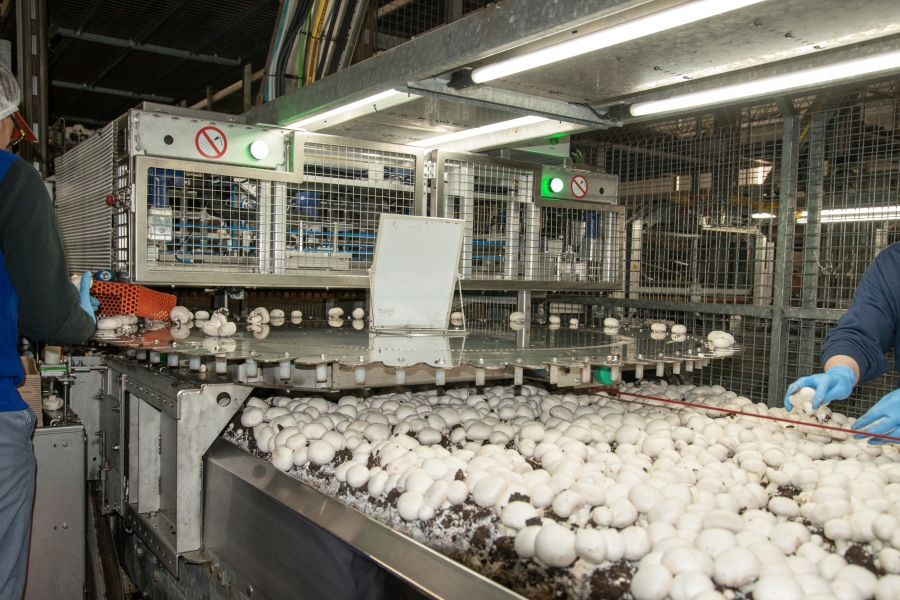
Commercial mushroom harvesting presents a uniquely difficult automation challenge.
Every mushroom differs in size, orientation, maturity, and accessibility. They grow in dense clusters, bruise easily, and mature continuously throughout the day inside warm, humid growing environments.
As Stefan explains, these conditions have made mushroom harvesting one of robotics' longest-standing unsolved problems, one that engineers have been attempting to automate for decades.
Unlike many industrial automation applications, success requires much more than precise motion. It demands machine vision, intelligent decision-making, delicate manipulation, and real-time adaptation.
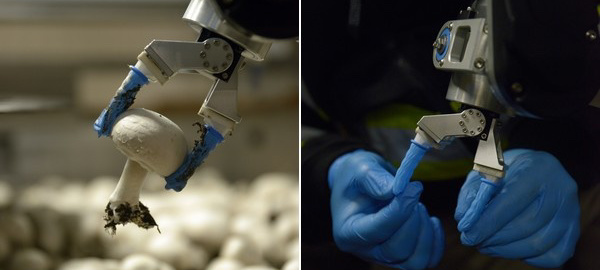
Rather than relying on conventional industrial grippers, Mycionics approached the problem by studying how experienced mushroom harvesters use their fingers.
Humans instinctively adjust pressure, angle, and movement while harvesting delicate mushrooms. Replicating that capability required designing robotic end effectors that interact gently with each mushroom while sophisticated computer vision continuously evaluates every harvest decision.
The result is a harvesting system capable of matching, and in many situations exceeding, human harvesting quality while working collaboratively alongside farm employees.
One of the podcast's most interesting insights is that the real innovation isn't only the robotic hand. It's the intelligence behind it.
Every harvesting decision begins with computer vision.
The same AI that enables robotic harvesting also creates detailed digital maps of every growing bed, measuring mushroom size, density, maturity, and growth patterns.
That technology has evolved into Crop Scout, Mycionics' crop intelligence platform.
Today, growers can use this information to:
In many ways, the data generated by the robot has become just as valuable as the harvesting itself.
The MaRS discussion places mushroom harvesting within a much larger movement happening across robotics.
Experts from prosthetics, surgical robotics, humanoid robotics, and industrial automation all point toward the same conclusion: advances in AI are rapidly improving a robot's ability to understand its environment.
The remaining challenge is physical interaction.
While language models have transformed digital intelligence, the next frontier is giving machines the ability to manipulate real-world objects with human-like precision.
For Mycionics, commercial mushroom farms have become an ideal proving ground for solving that challenge.
Another key theme throughout the episode is collaboration.
Rather than replacing workers, Mycionics has designed its harvesting platform to work alongside experienced harvesters, allowing robotics to perform repetitive harvesting tasks while people continue making higher-level decisions and handling more complex work.
This hybrid approach reflects a broader trend across industrial automation, where AI and robotics augment human expertise instead of replacing it outright.
The future of robotics will depend on far more than faster processors or larger AI models.
It will require machines that can see, understand, and interact with the physical world with the same adaptability humans demonstrate every day.
By tackling one of agriculture's most demanding harvesting applications, Mycionics is helping advance technologies that could influence robotics far beyond mushroom farming, from advanced manufacturing to logistics, healthcare, and beyond.
The MaRS Solve for X episode explores:
We encourage anyone interested in robotics, artificial intelligence, advanced manufacturing, or agricultural innovation to listen to the complete episode featuring Stefan Glibetic and an outstanding panel of Canadian robotics experts.
Category Podcast Summary
Featured Organization MaRS Discovery District
Featured Speaker Stefan Glibetic, CEO, Mycionics
Podcast Solve for X
Technology AI, Computer Vision, Soft Robotics, Crop Intelligence
Industry Robotics, Agriculture, Advanced Manufacturing
Topics Human Dexterity, Physical AI, Robotic Harvesting
Reading Time ~5 minutes
Resource Type Podcast Recap
Published By Mycionics
Curious to learn more? Check out our Resources page.

.svg)
.svg)


.svg)
.svg)


