.svg)


Every mushroom farm runs on two clocks, and they do not agree with each other.
The first is biological. A mushroom in its fast growth phase gains roughly 4% of its mass every hour, continuously, with no regard for the time of day. It grows at three in the morning at the same rate it grows at three in the afternoon.
The second clock is the roster. People arrive, work a shift, and go home. Some farms run two shifts. Very few run three.
The gap between those two clocks is one of the quietest and largest losses in the industry, and almost nobody talks about it.
Consider a bed that reaches its ideal size at two in the morning. The first picker reaches it at seven. In those five hours, the crop has kept growing.
The mushrooms are now larger than the grade that was ordered. Depending on how close they were to the edge, some of them have started to open. The bed that would have been a perfect run of buttons is now a mix, some of it downgraded.
This is not a rare event. It happens somewhere on every farm, most days, because the crop does not arrange itself to be ready at shift start.
Growers are not unaware of this. They manage it, and the main tool they have is to pick early.
If you cannot be there when the bed is perfect, the safe move is to harvest before it gets there. A mushroom that is slightly too small is still the right grade. A mushroom that has opened is not. So the rational response to an unpredictable harvest window is to build in a margin and pick under size.
That margin is weight the farm already grew and then chose not to take. It is a deliberate, daily decision to trade yield for certainty, and it is entirely reasonable given the constraint. It is just expensive.
The other coping mechanism is scheduling: deciding which rooms get picked first each morning, based on experience and a walk through the farm the evening before. Good growers are remarkably accurate at this. They are also making that call about dozens of beds from a handful of observations, in a dim room, at an angle, the night before.
Almost every conversation about robots on farms is about labour cost and labour availability. Those are real. But the night shift problem is a different argument, and in some ways a more interesting one.
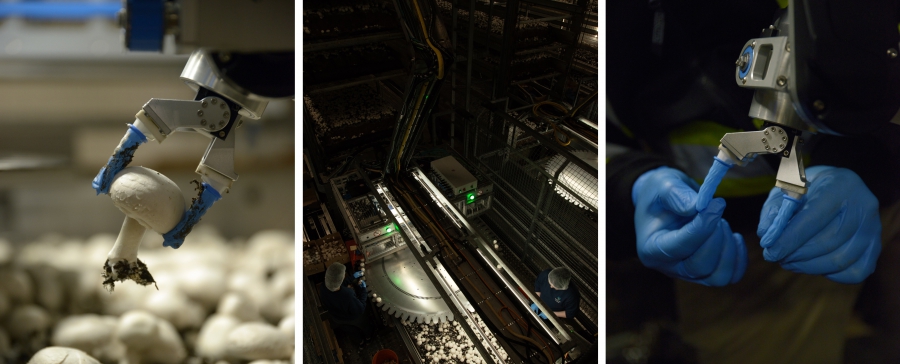
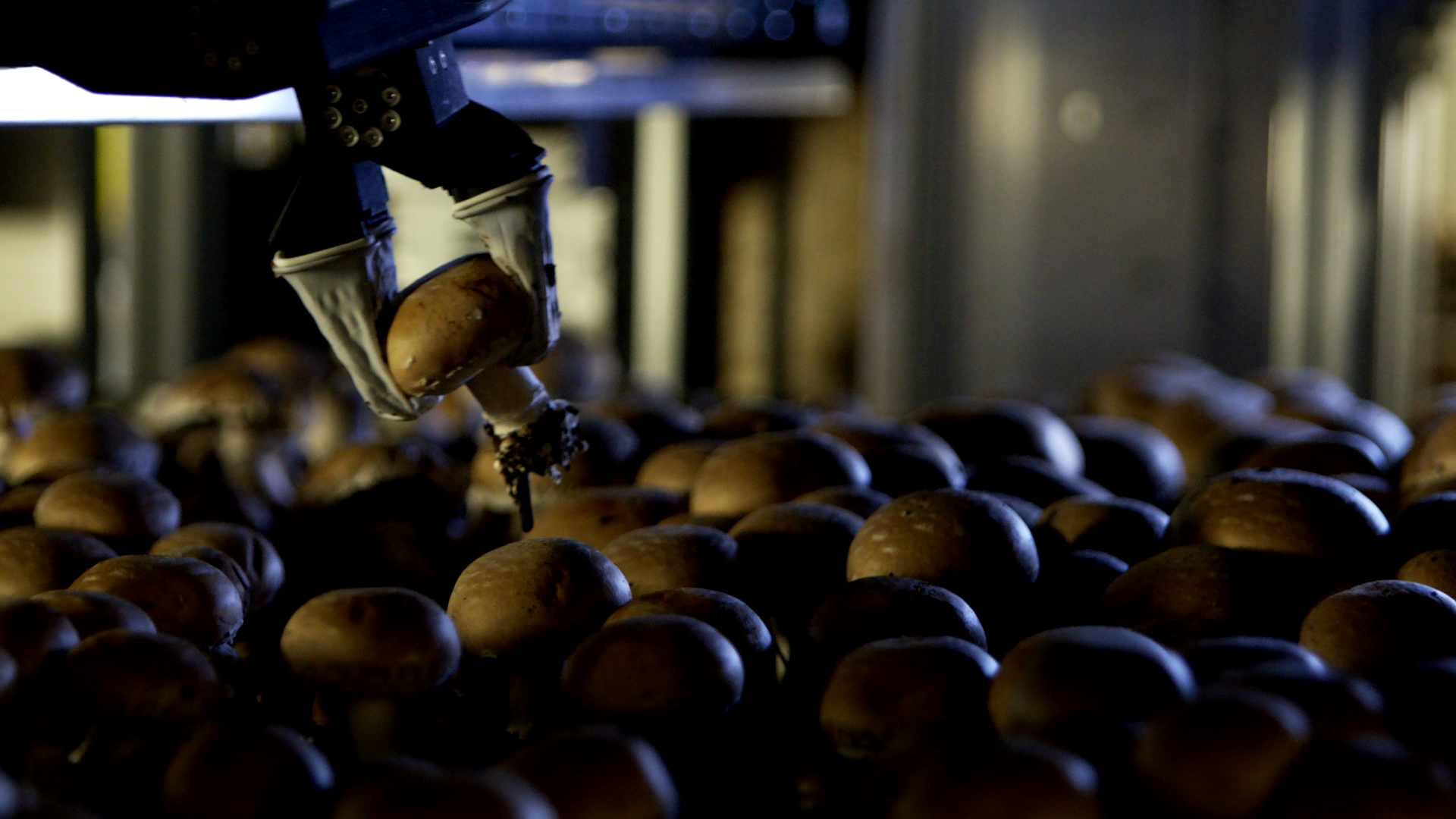
A machine does not need a shift. That is not a statement about speed. A robotic unit does not pick dramatically faster than a good picker over the course of an hour. What it does is exist at two in the morning.
That changes what the harvest window means. Instead of the crop having to be ready when the people are there, the picking can happen when the crop is ready. The farm stops picking early as insurance, because it no longer needs the insurance.
The same applies to knowing which bed to go to. A scanning system that measures every mushroom on every bed does not get tired at the end of a long day, and it does not have to guess from an awkward vantage point. It can tell a grower, before anyone starts, which rooms are peaking and which can wait.
It does not mean a farm with nobody in it. The skilled work on a mushroom farm, separating clusters, thinning beds, judging quality, managing the climate, still happens with people, during the day, and should.
What changes is that the repetitive half of the harvest stops being confined to the hours when the building is full. The crop sets the schedule instead of the roster.
When people outside the industry hear about mushroom harvesting robots, they hear a story about replacing workers. When growers hear about them, they usually hear a story about a labour problem they cannot solve.
Both of those miss something simpler. A crop that grows around the clock has been harvested on a schedule built around human working hours for as long as the industry has existed. Nobody designed it that way; it was the only option.
It is no longer the only option, and the value of changing it does not show up in a headcount at all. It shows up in the weight of the boxes.
Curious to learn more? Check out our Resources page.
.svg)

.svg)


.svg)
.svg)


