.svg)


Which type of infrastructure a farm builds decides more about what can be automated than any question about the robot itself, and it is the thing most people from outside the industry miss.
The traditional layout, and still the great majority of farms operating today, is fixed shelving. Long aluminium racks run down a growing room, five or six beds high, with narrow aisles between them. The compost is filled mechanically into the beds and stays put for the whole cycle.
Because the beds do not move, the picker does. They work from a platform or trolley that raises and lowers along the aisle, moving to each bed in turn, reaching in, picking, cutting and packing.
Many modern shelf farms run a conveyor along the aisle, often called a blue belt, that carries picked mushrooms out to a central point. That single addition changes the economics of the room more than it appears to, because it means one part of the job no longer has to happen at the bed.
The older version of this layout uses wooden trays instead of aluminium shelving. Trays get moved around the farm by forklift and are the most labour-intensive arrangement still in commercial use. They are slowly disappearing.
The newer approach turns the problem around. Instead of the person travelling to the bed, the bed travels to the person.
Each level of the rack is a drawer that can be pulled out onto a moving platform and presented at working height, one after another. The picker stands in one place and the crop arrives in front of them.
Drawer systems are expensive to build, so they appear mostly in new farms and major expansions rather than retrofits. They are also noticeably better places to work: no climbing, no reaching over your head, no walking a mile a shift.
Here is the practical consequence.
On a shelf farm, the crop is fixed in place and spread across an entire room. A machine that wants to pick it has to travel: navigate the aisle, change levels, find its position, avoid people, and carry everything it needs with it. Mobile machines are complex, expensive and fragile, and a large share of their running time is spent moving rather than working.
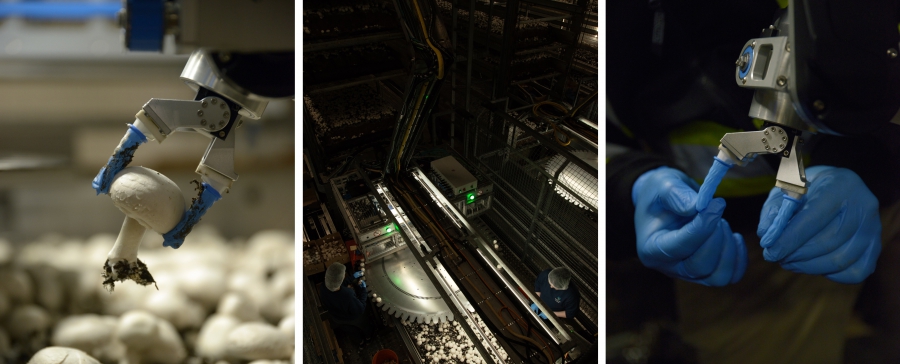
But there is a second option on a shelf farm, and it is a much better one. Do not automate the picking. Automate the task that already happens in one place. With a belt in the aisle, the picker can pick with both hands and put uncut mushrooms on the belt, and the cutting, weighing and boxing can all be done by a machine at the end of the line. That one change takes roughly half of the harvest work off the bed, and it needs no change to the room.
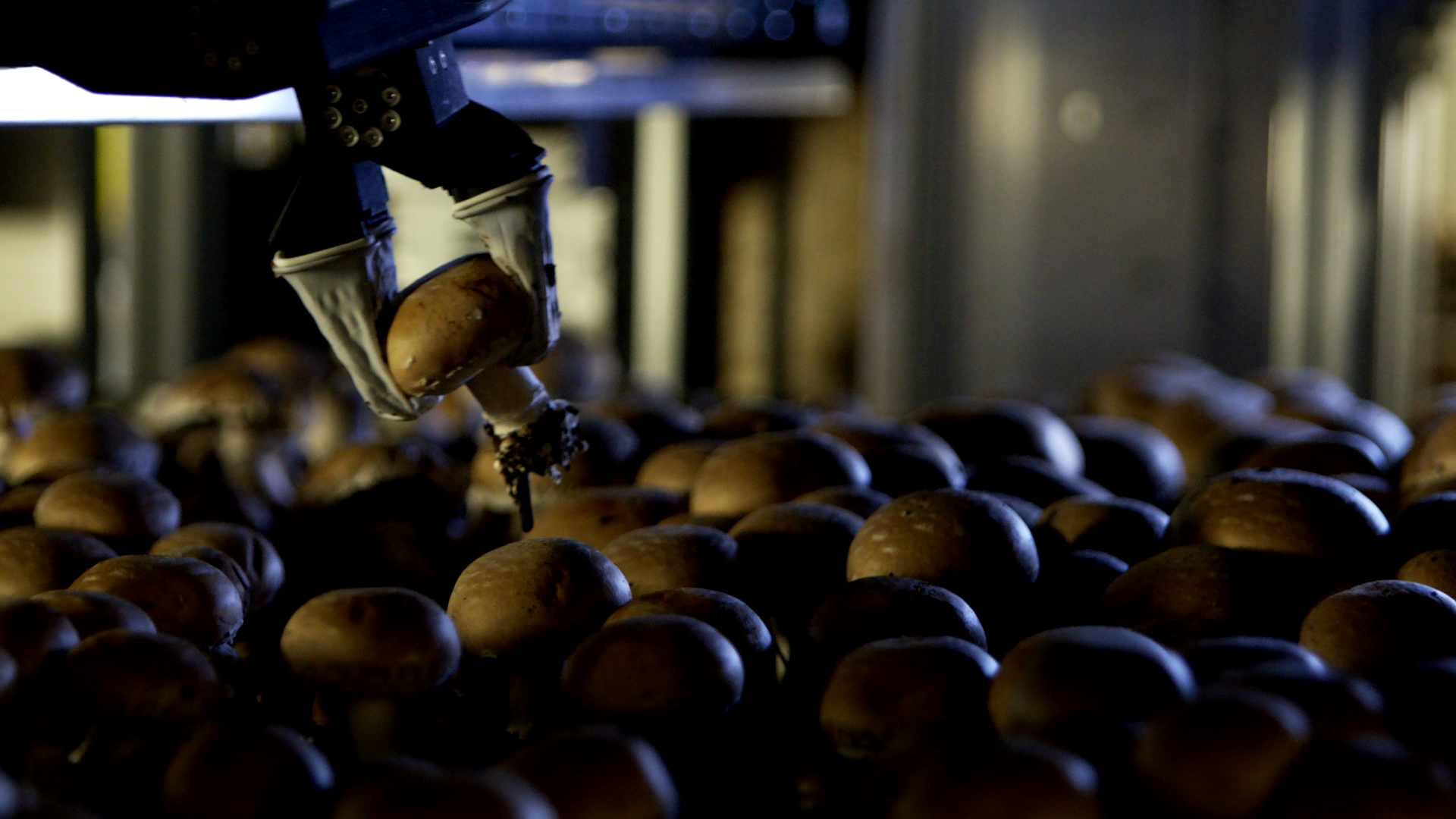
On a drawer farm, the crop is already coming to a fixed point. That means a machine can sit in that spot, bolted to a frame, and work on every bed as it arrives. No navigation, no mobile base, no travel time. Both the picking and the packing can be automated by units standing still.
It is tempting to conclude that drawer farms are simply the future and shelf farms are the past. That is not how this industry works.
Shelf farms represent an enormous amount of built infrastructure that is nowhere near the end of its life. A grower with a working room full of aluminium racks is not going to demolish it because a better layout exists. They will run it for another twenty years, and they still need a way to harvest it.
At the same time, nearly every new farm and major expansion being designed now is looking hard at drawer systems, partly because of the labour arithmetic and partly because they are better places to work.
So the honest picture of this industry over the next decade is both at once: a very large installed base of shelf farms that needs a retrofit answer, and a growing set of new drawer farms that can be designed around automation from the floor up.
This is why our systems are modular rather than a single machine. The same two-arm unit picks or packs depending on the tool it carries. On a shelf farm it takes over packing at the end of a belt. On a drawer farm it sits on the rack and does both, alongside the crop-scanning system.
A company that only serves new builds is waiting for farms to be built. A company that only retrofits has nothing to offer the farms being designed right now. The infrastructure question comes first, and the answer has to cover both sides of it.
Curious to learn more? Check out our Resources page.
.svg)

.svg)


.svg)
.svg)


