.svg)


If you ask an automation engineer how to pick something up, the first answer is usually a suction cup. They are cheap, simple, fast and have no moving parts to speak of. Most pick-and-place machines in the world use them.
We spent about a year trying to pick mushrooms with suction before giving up on it. Here is why it does not work, because the reason explains most of what is difficult about this crop.
A skilled picker does not lift a mushroom. They grip the sides of the cap with two or three fingers, tilt it over, add a slight twist, and lift. The whole motion takes under a second and they barely touch the top of the cap at all.
That sequence is not habit. It is the only motion that works, and the reason is underground.
A mushroom is not sitting on the compost. It is growing out of it, attached by its stem to the mycelium below.
The important detail is which bond is weaker. The joint between the cap and the stem is weaker than the grip of the compost on the stem. So if you pull a mushroom straight upward, the cap comes off in your hand and the stem stays in the bed. You have destroyed the product and left a stump that will rot.
Tilting changes the geometry. It puts the force across the anchor rather than against it, and the stem releases cleanly, whole.
A vacuum cup pulls in exactly one direction: straight along its own axis, away from the surface it is stuck to. That is its entire trick.
To tilt a mushroom with a suction cup, you have to drag the cup sideways across the cap while it is still stuck down. Do that and one of two things happens. Either the seal breaks and you drop the mushroom, or the seal holds and you shear the skin of the cap.
Increase the vacuum to stop it slipping and you make the second outcome worse, because now you are pressing harder on the most delicate surface on the farm.
This is the part that makes mushrooms unlike almost anything else a machine handles.
An apple has a skin. A potato has a skin. A mushroom has neither. Its surface is the flesh, and when you bruise it, nothing happens immediately. The mark develops over the following day or two, as the tissue browns, which is exactly the period when the box is travelling to a distribution centre.
So a machine can pick a bed, inspect its own work, conclude everything is fine, and fail the customer's inspection 48 hours later. You cannot tune a gripper by looking at the bed. You tune it by looking at what comes out of the cooler.
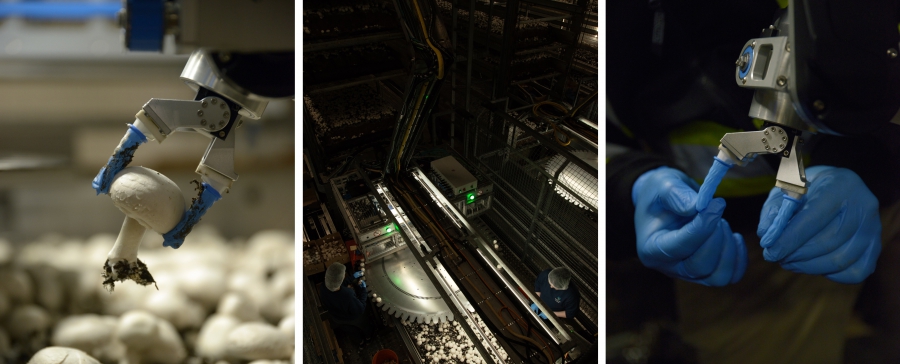
Once you accept that the motion has to be a tilt and a twist, you need something that can hold the sides of a cap while doing it. That means fingers, and fingers that behave like the ones on a hand.
A human finger is a firm core wrapped in something soft. The bone carries the force; the flesh spreads it over a wider area so the pressure at any one point stays low. A rigid robotic finger concentrates all its force into a small contact patch, which is a bruise.
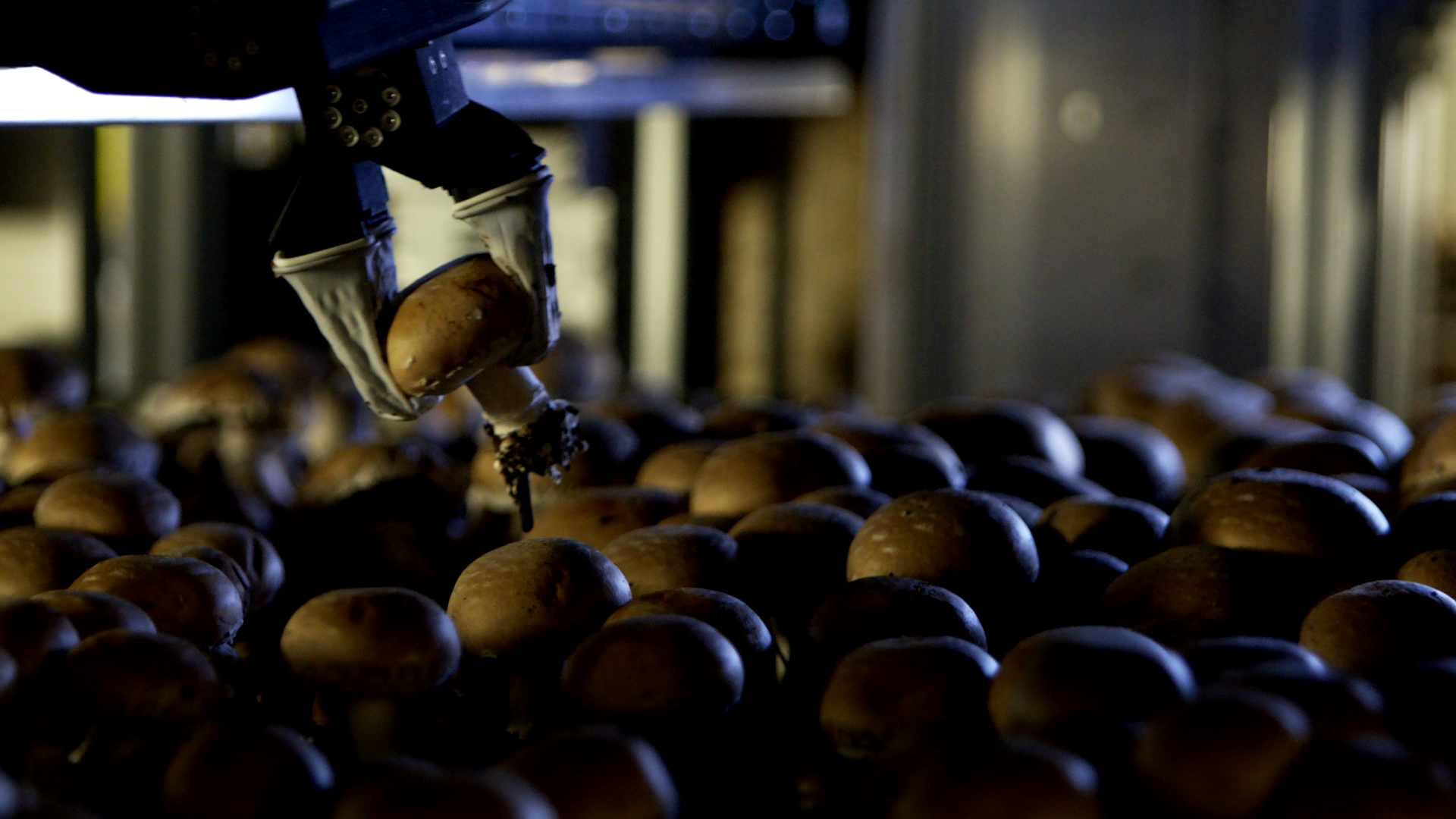
So our fingers are built the same way: a stiff backbone to transfer force, a soft outer layer that conforms to the curve of the cap, and force sensing so the grip stops tightening once it has enough.
A human hand has roughly 27 independent movements. Reproducing that in a machine is possible in a research lab and impossible at a price a farm would pay.
The useful insight is that the pick only needs three of them: where to grip, how much force to apply, and what path to move through. Everything else a hand can do is irrelevant to this task. Build those three properly and you do not need the rest.
There is one more advantage to fingers that has nothing to do with mechanics.
Human harvesters wear blue nitrile gloves, changed on a schedule, as part of the farm's food-safety procedure. Our robotic fingers wear the same gloves, from the same box, changed the same way.
That means the farm does not have to write a new hygiene procedure for the robot, or explain a new material to an auditor. A suction cup, by contrast, draws air across the cap and into a line, which on a bed covered in compost and spores is a cleaning problem rather than a picking one.
The obvious tool was wrong here for a specific reason: the task is not lifting, it is releasing. Suction is very good at lifting and cannot release anything that is held down.
Most of what is hard about automating agriculture looks like this. The machine that works is rarely the one that mimics a factory. It is the one that copies what the person was already doing, once you understand why they were doing it that way.
Curious to learn more? Check out our Resources page.
.svg)

.svg)


.svg)
.svg)


