.svg)


People ask us why a robotics company would choose mushrooms. It sounds like a narrow place to start. It is actually one of the most interesting problems in agriculture, for reasons that have nothing to do with mushrooms being fashionable.
Measured by output per square foot, nothing in agriculture comes close to a mushroom bed. An acre of growing bed produces roughly a million pounds of mushrooms a year.
Then consider that the beds are stacked. A typical growing room holds five or six levels, one above another, which means an acre of building contains several acres of bed. A field crop gets one layer and one season. A mushroom farm gets six layers and no season at all.
Mushrooms are grown indoors in climate-controlled rooms, on compost made largely from other farms' by-products. There is no weather, no planting window and no harvest window. Rooms are filled, cropped and emptied on a rolling five-week cycle, continuously, every week of the year.
It is also a light crop on resources. Growing a pound of mushrooms takes roughly 1.8 gallons of water and about a kilowatt-hour of energy, on land that is a building rather than a field.
In other words, mushroom farming solved indoor vertical growing decades before anyone used that phrase.
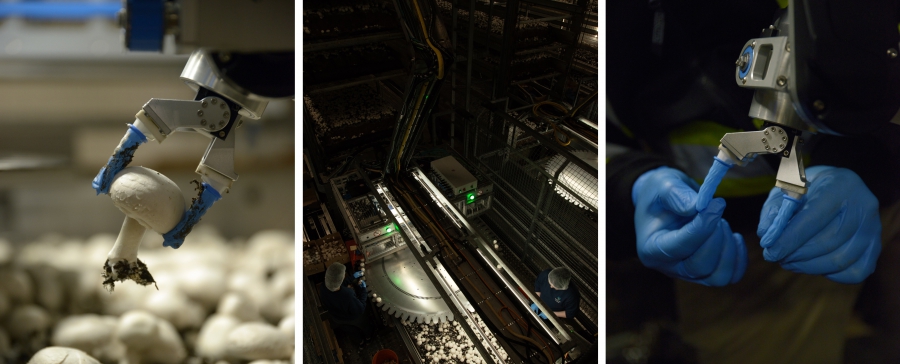
Here is the part that surprises people. In a sector this industrialised, with automated composting, automated filling, climate control and conveyors, the actual harvest is still done exactly as it was fifty years ago: by a person, one mushroom at a time.
There is no machine on most farms between the mushroom on the bed and the box it ships in. Picking is skilled, fast, delicate work, and it is the single largest cost on the farm.
The consequence is that a mushroom farm's real ceiling is not how many mushrooms it can grow. It is how many pickers it can find. Farms across North America and Europe cannot fill the positions, and rooms get harvested late while the crop keeps growing.
Most agricultural robotics faces a brutal duty cycle. A machine built to harvest strawberries or apples works a few weeks a year, outdoors, in variable weather, on uneven ground, and has to earn a year of cost in that window.
A mushroom room is the opposite of a field. The temperature and humidity are set. The light is whatever you bring. The beds do not move, and their dimensions are known. The crop is there every day of the year, which means a machine can work roughly 350 days a year in the same place. For anyone building equipment that has to pay for itself, that is the best duty cycle in agriculture.
It is also the hardest manipulation problem we know of in farming.
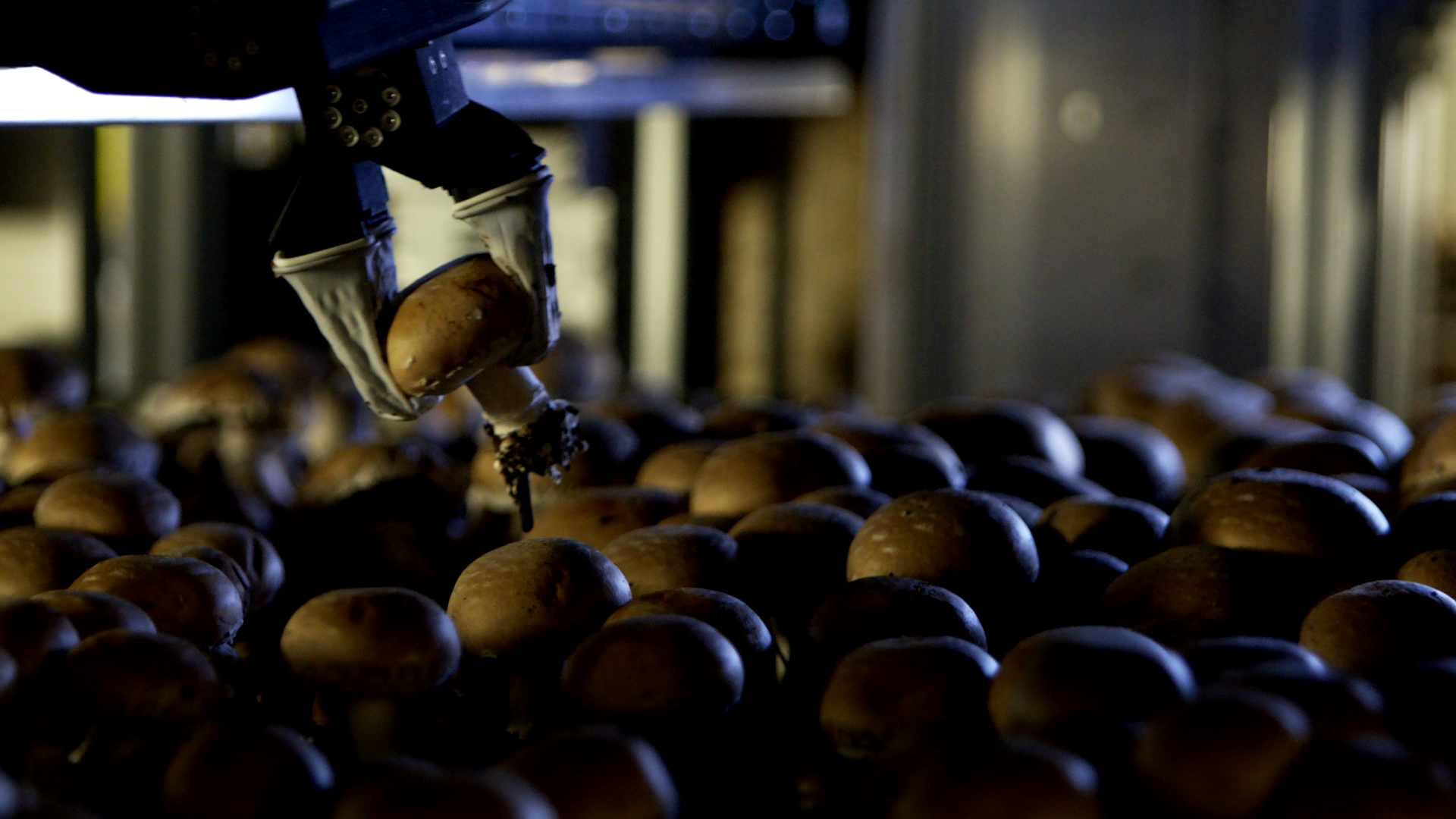
A mushroom has no protective skin. Press it slightly too hard and the damage does not appear until two days later in the cooler, by which point it is somebody else's problem. It grows in dense clusters where the one you want is touching three you do not. It is a different size every hour. It sits on a bed of compost that holds it in place, so it has to be released rather than pulled. And all of this happens in a warm, humid room that destroys equipment built for a factory floor.
That difficulty is exactly why the problem stayed open for fifty years while easier crops got automated first. It is also why solving it matters beyond mushrooms: a machine that can handle a soft, irregular, living object that is never the same twice is a machine that transfers to a lot of other produce.
A crop with the highest output per square foot in agriculture. Grown indoors, every day of the year, in a controlled and predictable space. Entirely dependent on hand labour that is getting harder to find every year.
The best working conditions a farm robot will ever get, attached to the hardest thing a farm robot has ever been asked to pick. That is why mushrooms.
Curious to learn more? Check out our Resources page.
.svg)

.svg)


.svg)
.svg)


