.svg)


The brochure version of farming's future is a dark, empty building where machines do everything and nobody is on shift. It is a good picture. Stand in a real growing room for an afternoon and it falls apart.
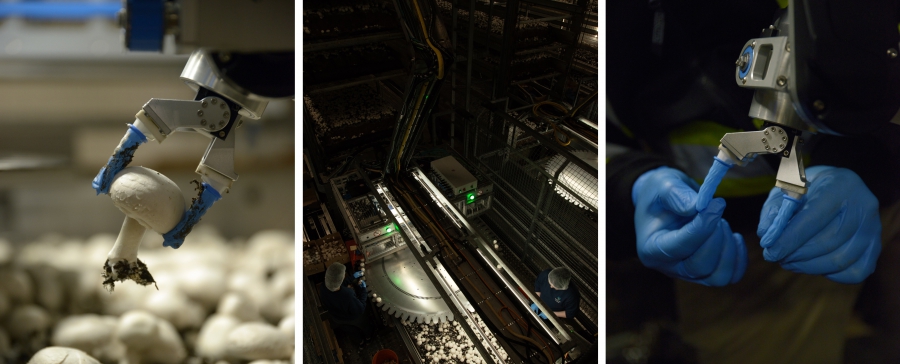
A mushroom room is warm and close to saturated with humidity. Carbon dioxide runs high. Every surface gets washed down and sometimes steamed. Compost dust and spores hang in the air. Lighting is whatever the room has. This is not a factory floor, and equipment built for a factory floor does not last in it.
Standard industrial robots are designed for dry, bright, predictable spaces. On a farm they meet the opposite. Seals that pass a factory dust rating still let humid air creep into a housing. Lubricants that are normal in a plant are not acceptable near food. Cameras built for a conveyor cannot focus at the short distances between stacked beds, and they expect lighting that a growing room never provides.
None of this is unsolvable. It just means the machine has to be built for the room rather than adapted to it, and that changes what is worth automating.
A human hand has around 27 independent movements and force feedback in every fingertip. A picker uses all of it without thinking: find the mushroom in a cluster, judge whether it is ready, grip the sides of the cap, tilt, twist, lift, and place it without ever pressing hard enough to bruise it.
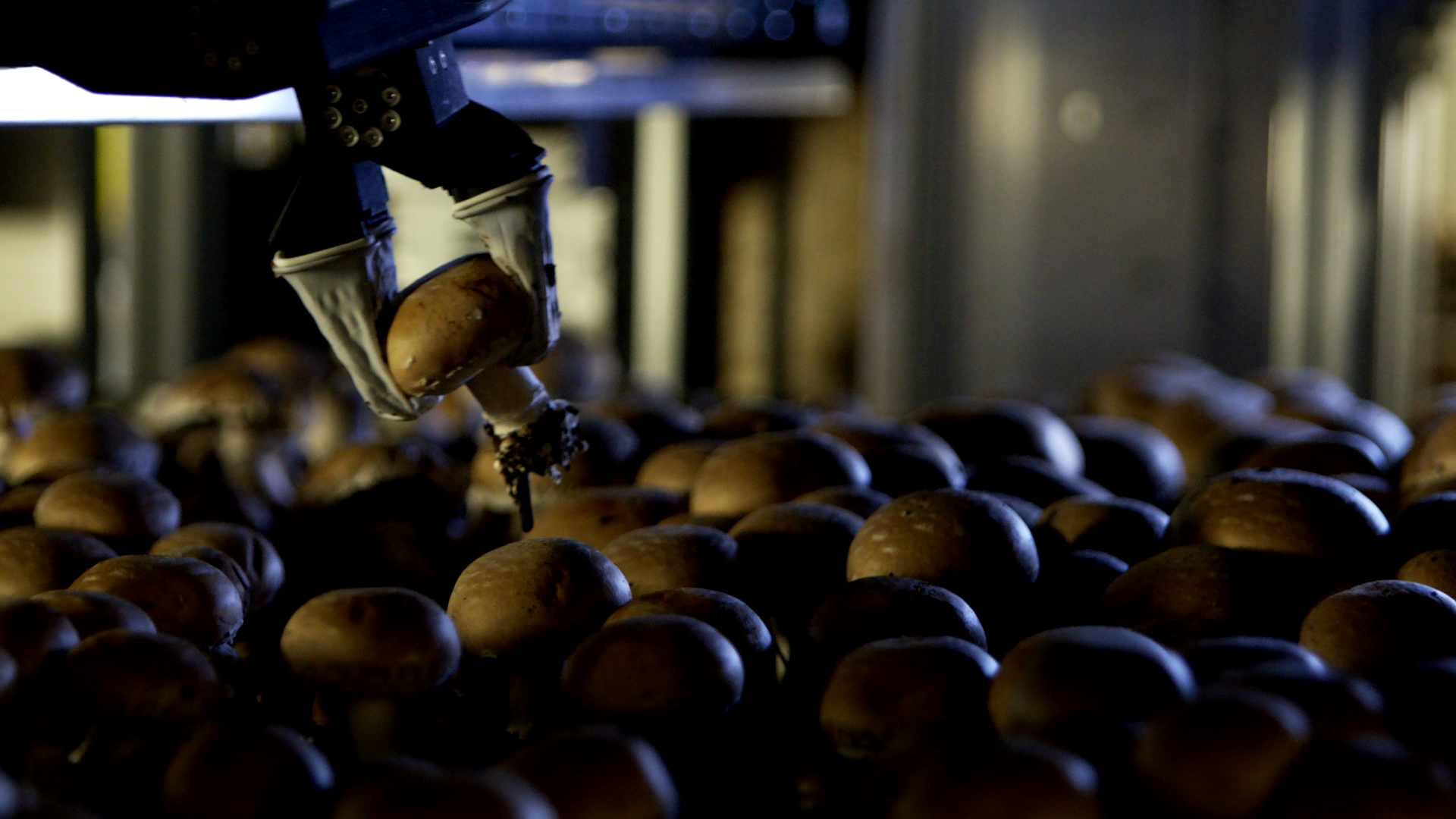
Copying all of that is neither possible at a sensible cost nor necessary. Only three things actually matter for the pick: where to grip, how hard to hold, and what motion releases the stem. Build those three well and the rest of the hand is decoration.
But a picker also does things no machine is close to. They reach into a dense cluster and separate it. They notice a patch of the bed that looks wrong and tell the grower. They decide to leave a mushroom for tomorrow because of what is growing next to it. That judgment is the expensive part of the job, and it is the part worth keeping.
Manufacturing spent years discovering the same thing. Collaborative robots exist because plants found that machines working next to people, at a human pace, stopping when touched, outperformed both fully manual lines and fully automated ones. One of the best known car makers over-automated an assembly line, then reversed course and put people back on it.
The pattern repeats because it is not a technology limit. It is an economics limit. Every additional percent of a job you automate costs more than the last one, and the final stretch, the edge cases, costs more than all the rest combined.
The reaction on the farm surprised us. We expected resistance. What we mostly got was people asking the robot to take the parts of the job they liked least: the repetition, the reaching, the endless cutting and boxing. Nobody argued for keeping the dull half.
Mushroom picking is physically hard work in an uncomfortable room, and farms struggle to fill the positions and keep them filled. Handing the repetitive half to a machine makes the remaining job easier to do and easier to hire for.
There is one more argument for the hybrid approach, and it is the least glamorous. Equipment on a farm has to be fixable by the farm.
The crop grows through the night. If something stops at two in the morning, nobody is flying in a specialist. The maintenance person on shift needs to swap a part with ordinary hand tools and get the room moving again, or put people back on the bed and carry on. Anything that fails that test is an expensive ornament.
The more of the job a machine tries to do, the more of it there is to break. Simplicity is not a compromise here. It is what keeps the room running.
Waiting for a machine that does the entire job means doing nothing for years while the labour problem gets worse. Splitting the job today means the repetitive work gets done by something that does not tire, and the skilled work gets done by people who are no longer worn out by the rest of it.
The question worth asking is not when robots take over the harvest. It is which half of the harvest they should take, and what your people should be doing with the time that gives back.
Curious to learn more? Check out our Resources page.
.svg)

.svg)


.svg)
.svg)


